
Irina Kinchin, PhD, MSc
Health Economist
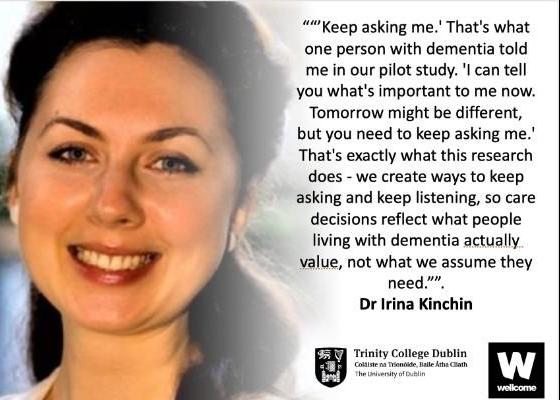
Health economics needs to do a better job of reflecting what matters to people living with dementia and those who support them.


Current Work
Irina is an a health economist and Research Associate Professor at the Trinity College Institute of Neuroscience (TCIN), School of Medicine, Trinity College Dublin, and faculty and Atlantic Fellow for Equity in Brain Health at the Global Brain Health Institute (GBHI).
She currently leads Valuing Vanishing Voices: creating empowerment and inclusion in health economics as Principal Investigator on a Wellcome Career Development Award. Through longitudinal and creative approaches, co-design and the development of the VOICE toolkit, this programme explores new ways of measuring and valuing quality of life for people living with dementia. The aim is to develop more inclusive approaches to outcome measurement that can be adapted across brain health research and practice.
Personal Hero
Words of Strength
Voice. Value. Vision.
Vision
Irina’s vision is for health economics to do a better job of reflecting what matters to people living with dementia and those who support them. Too often, the outcomes that shape everyday life are not fully reflected in research, service planning and resource allocation.
She also wants to support the next generation of researchers working at the intersection of health economics, brain health and ageing, helping to develop more inclusive approaches to research and decision-making.
Strategy
Irina's work combines health economics, co-design and creative research methods to explore what matters most to people living with dementia and how these priorities can better inform research and decision-making. Through the VOICE toolkit and the broader Valuing Vanishing Voices programme, she aims to develop approaches that can be used by researchers, clinicians and decision-makers across different brain health settings. A key part of this work is building interdisciplinary research capacity through mentoring and supporting early career researchers.
Motivation
Irina's motivation has been shaped by working with diverse populations across Australia and Ireland, including Indigenous communities, people affected by mental illness, those approaching the end of life, family carers and people living with dementia. Despite the differences between these settings, She encountered the same challenge repeatedly: the people most affected by decisions were often the least involved in shaping them.
That experience led Irina towards brain health research and continues to influence her work today. It has also reinforced the importance of supporting the next generation of researchers to work alongside communities, people with lived experience and health services in developing evidence that reflects what matters most to people.
Education & Experience
Before joining Trinity College Dublin, Irina held research positions at the University of Technology Sydney, Central Queensland University and James Cook University. Across Australia and Ireland, her work has spanned Indigenous health, mental health, ageing, palliative care and dementia.
She holds an MSc in Health Economics from the University of York and has worked in applied health economics research for more than a decade. She has partnered with policymakers, healthcare services, community organisations and people with lived experience to ensure that research can inform real-world decisions.
Irina serves as Associate Editor of Quality of Life Research and the International Journal of Technology Assessment in Health Care, and contributes to international research assessment through roles with NIHR Programme Grants for Applied Research, the MRFF Clinician Researchers Initiative, iHEA, ISPOR.