In this perspective, Atlantic Fellow Lenisa Brandão shares the lessons she gathered while walking the Camino de Santiago during Walking the Talk for Dementia, alongside people living with dementia, their loved ones, artists, and health professionals who, like her, are dedicated to this field.
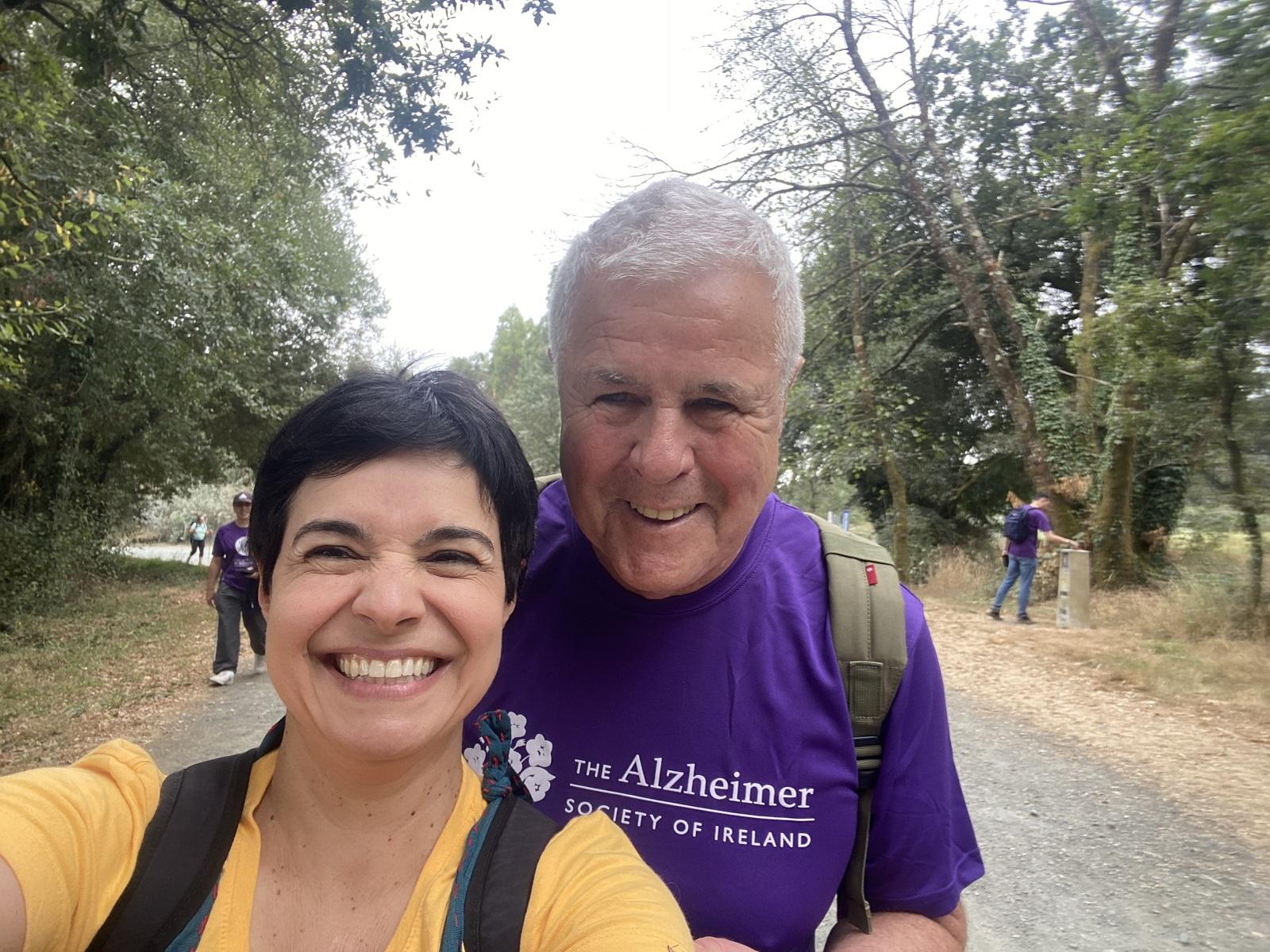
Lenisa and Kevin during Walking the Talk for Dementia.
Imagining an Authentic Old Age
At a café on the morning before the walk, I saw a woman with short white hair, wearing a denim miniskirt and with one arm in a sling, accompanied by a young man. When she stood, she leaned on him with dignity and peace.
That scene moved me to tears. I saw my own old age — the possibility of sustaining authenticity and strength even in the face of limitations. Only later would I realize that this was the beginning of the awakening that the walk would bring.
Living in the Present Moment
In a conversation with Kevin, a captivating Irishman with penetrating eyes and white hair, he allowed me to glimpse his awareness of himself and of dementia.
He said: “I live in the present moment. I think: I have dementia, that is difficult, but I am still alive and in touch with reality. Even if I forget the moment that just passed, in the next one I am once again present.”
For him, being on that walk meant acknowledging his condition in front of others, while also feeling he belonged to a community that accepted him as he is.
Caring for the One Who Cares for Me
When I met Tom, Kevin’s partner, the wheel of understanding turned once again. He is not just a caregiver: he also feels cared for by Kevin. He is full of gratitude for his life. He loves and takes care of himself, so that he can be whole in the face of love and life.
Sustaining Oneself Through Self-Love
Thérèse, a delicate, elegant, and strong Irish woman, with a luminous smile, lives with frontotemporal dementia. She introduced herself with confidence and openly shared her diagnosis without hesitation.
Walking together, we spoke of solitude, spirituality, friendship, and family disappointments. She told me that when she received her diagnosis, she understood that she would be facing into it without any partner to support her — and that it was all right.
She has a loyal friend who loves her, but she would not allow that friend to give up her life to care for her. She did not feel abandoned. Her peace was radiant.
If Thérèse exists and walks with such courage, then I too can believe in myself and in the God who accompanies me.
Understanding Bad Days and Being an Emotionally Empowered Leader
Laurie, an American woman with vibrant presence and an authentic gaze, was one of the event organizers who impressed me most.
She told me that, on bad days, she could put her underwear on over her jeans. She was able to recognize that frightening moment as something not definitive, but as the reflection of a memory lapse — a fluctuation — and she handled it with wisdom.
She also spoke of the fear her partner had of her decline, of the strategies she created to remain active, and of her effort to preserve autonomy.
She showed me a different kind of leadership: firm, open about her needs, conscious of asking for help, and a reference point for everyone. Laurie is love too.
Remaining an Individual and Accepting Help
There was Alan, an Englishman, serene, with slow gestures and a peaceful expression, who emanated the calm of one who knows he is loved, and his wife Karen, captivating, gentle, and loving, who allowed herself to live with freedom — even cycling alone whenever she felt like it.
When Karen stepped away to speak with someone else I stayed with Alan and offered to help him with his jacket. I felt honored to support him, moved by his openness and humility in the face of such a simple gesture.
It was a moment of silent beauty.
Learning From Other Encounters
I met other beautiful people along the way.
The tireless Julio, a Colombian of inexhaustible energy and long strides, and his lovely daughter Carolina, tender and always smiling, walked together in deep companionship.
Vanetha, a Malaysian woman with an easy laugh and proud gaze, told me she carried out her role as a grandmother with humor and dignity.
The Brazilian Rogerio and his wife Karin, always united, radiated simplicity and joy in their eyes.
Bobby, who lives in Australia, an authentic warrior, overcame herself at each step with the strength of a lioness.
Cyndy, an American woman with direct and courageous speech, spoke before everyone with raw and necessary truth, reminding us that it is essential to use short sentences when speaking with a person living with dementia.
Mike, who came from America with his family, seemed introspective in his walk. He showed us how much energy and charisma he really had when he danced at our party, swinging his wife with firm and precise movements!
Audrey, a strong and sensitive Scottish woman, shared a deep invitation to walk with her through the song she wrote and shared at the symposium.
The Deepest Message
I will carry the beauty and wisdom of these wonderful people as strength for the years ahead.
On the path, I discovered that, in life’s impermanence, love blooms — and that dementia has no power over love.
Authors

Lenisa Brandão, PhD
Speech Therapist