In this perspective, Atlantic Fellows Carlos Coronel and Agustín Ibáñez, GBHI Faculty member and Scientific Director of BrainLat, discuss how creative experiences can delay brain aging. Their ideas may inform current calls to increase creativity as a social prescription and as an intervention across diseases and healthy aging.

Brain Clocks and Brain Health
One of the best ways to understand how the brain changes with age is through brain clocks. These computational tools learn from brain data to estimate a person’s brain age. By comparing brain age with real chronological age, we can see whether a brain is aging faster or slower than expected. The difference, called the brain age gap, serves as a general score of brain health. Larger gaps indicate accelerated aging, while smaller or negative gaps reflect a younger, healthier brain. Brain clocks have already revealed accelerated aging in conditions like unhealthy aging or dementia. But until now, little is known about how positive experiences, such as creativity, might slow this process down.
Creativity and Delayed Brain Aging
We tested this question in more than 1,400 participants from 13 countries, including the ReDLat and EuroLad-EEG consortia, and creativity data from multiple sites in Latin America and Europe. We developed brain clocks with electroencephalography and magnetoencephalography. These techniques, common in the field of human electrophysiology, are used to measure brain electrical activity. When we compared groups, experts in all creative activities have younger brains. The effects of creativity were similar across different types of artistic activities. Tango dancers in Argentina, musicians in Canada, visual artists in Germany, and gamers in Poland all showed younger brain ages than non-experts of the same age, sex, education, and country. The results scaled with expertise: the more years of practice, the younger the brain. Even short-term learning made a difference. Participants with no previous experience who trained on a strategy video game showed measurable improvements, suggesting that benefits can be achieved without being a professional.
The Biology of Creativity’s Protective Effects
Using computational models, we found some biological evidence about why creativity has this protective effect. We used three different tools. Biophysical models, a combination of mathematical modeling and empirical data, showed that creative practice strengthens the coupling between brain regions, helping maintain more efficient communication patterns. With graph theory analysis, we found that the brains of people with greater creative experience had more efficient networks, a hallmark of slower aging. And through Neurosynth, a platform that scans thousands of brain imaging studies to link brain regions with mental functions, we found that the areas most influenced by creativity were linked to rhythm, attention, and imagination—functions linked to creativity and most vulnerable to aging.
Creativity and Public Policies
These findings call for creativity to play a greater role in public health. Creative activities are affordable, enjoyable, and present in every culture. They could be promoted through community programs and social prescription as complementary approaches to preserve wellbeing and support prevention. Creativity may protect brain health, and our study adds to the growing evidence for integrating the arts and creative activities into global strategies for healthy aging.
Publication
Creative experiences and brain clocks. Nature Communications, 2025. https://doi.org/10.1038/s41467-025-64173-9
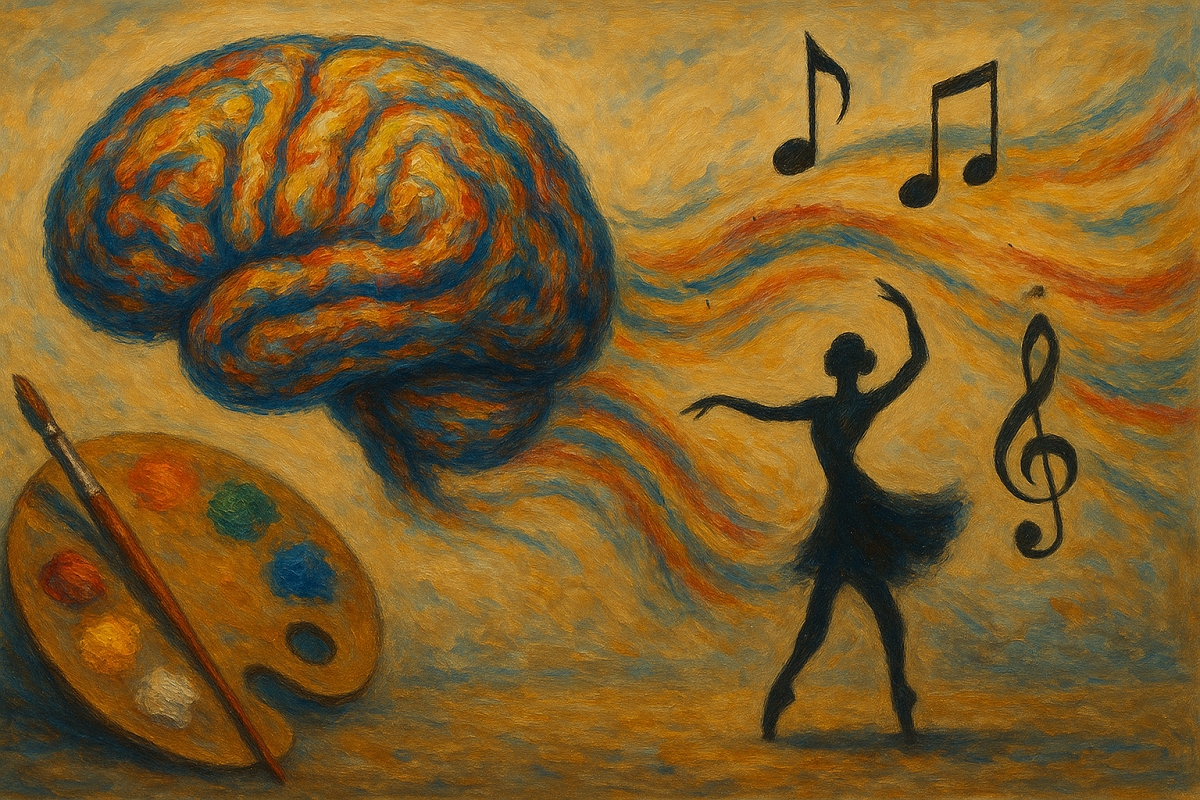
The figure has been designed by artificial intelligence under the supervision of the authors, Atlantic Fellows Carlos Coronel, and Agustín Ibáñez, GBHI faculty member and Scientific Director of BrainLat—the Latin American Brain Health Institute.
Authors

Carlos Coronel, PhD
Neuroscientist

Agustín Ibáñez, PhD
Neuroscientist