In this perspective, Atlantic Fellows Adolfo Garcia and Chi‑Udeh‑Momoh—along with Fernando Johann, Vaibhav Narayan, Irene B. Meier, and Karen Blackmon—explore how digital speech biomarkers can advance brain health equity through innovative work in Kenya.
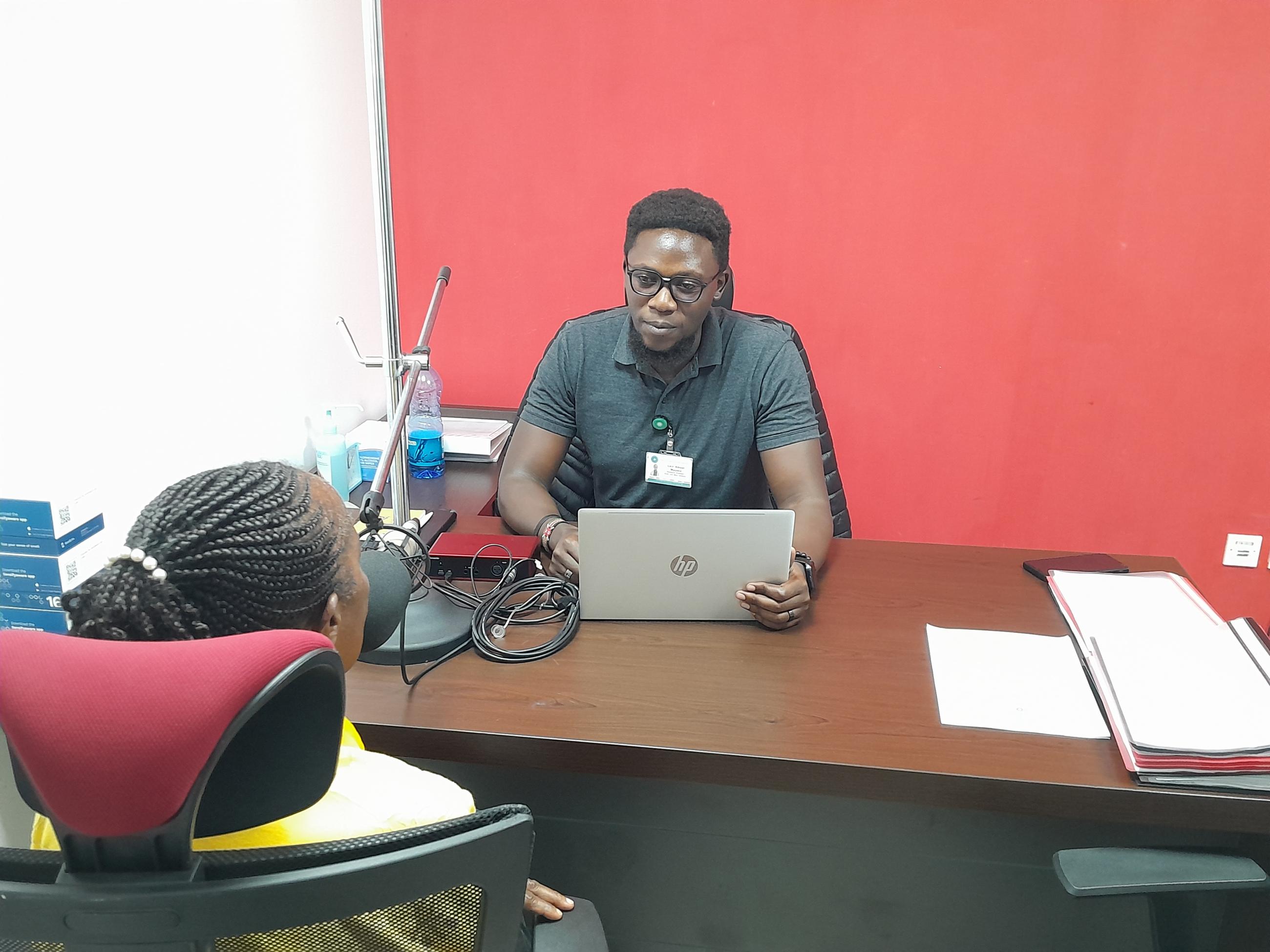
A Kenyan neuropsychologist collecting speech samples via TELL in a memory clinic in Nairobi. Photo courtesy of Karen Blackmon.
A leading trend in global health is the growth of aging-related brain disorders. These include mild cognitive impairment (MCI), a form of neuropsychological decline that does not hinder daily activities; and Alzheimer’s dementia (AD), a clinical disorder affecting memory and functional skills. Such conditions can be very challenging for individuals and place a heavy burden on their families, but early detection can help reduce their impact. In recent years, this objective has been facilitated by digital speech biomarkers, automated measures of acoustic and linguistic anomalies in verbal production. These tools are robust for detecting, characterizing, and monitoring MCI and AD in cost-effective, time-efficient, real-world settings. Accordingly, they are frequently advocated as powerful breakthroughs for equitable assessments in under-resourced communities.
Yet, this potential is far from realized. Most research studies, clinical trials, and implementation efforts are concentrated in institutions from high-income countries, so that speech biomarkers may actually be broadening existing disparities. Countering this scenario requires concerted efforts from clinical, scientific, technological, and funding institutions with a shared commitment to brain health equity, especially in low- and middle-income countries. The benefits and challenges of such efforts are illustrated by the incorporation of the Toolkit to Examine Lifelike Language (TELL) in Aga Khan University (AKU), through a dementia research study funded by the Davos Alzheimer’s Collaborative (DAC).
More widespread implementations of this collaborative model—grounded in local contexts, languages, and needs—will help reduce the disparities marking the global brain health landscape.
—Authors
Giving Kenya a Voice
TELL is a validated, award-winning web-based app enabling the acquisition, encryption, storage, preprocessing, analysis, and visualization of speech and language data. Since 2024, this tool has been used by AKU, whose transdisciplinary clinical teams are transforming the brain health agenda in Africa. The operation is enabled by DAC, a partnership committed to aligning disparate stakeholders for a global response to the challenges that AD presents to patients, caregivers, and health care infrastructures. Together, these institutions are running a significant study to establish robust speech biomarkers to detect MCI and AD in Kenyan older adults. This represents an innovative and promising effort with the potential for adaptation in other countries facing constraints—such as limited clinical capacity, a lack of validated assessment tools, and rising rates of cognitive impairment.
The synergy of TELL, AKU, and DAC resulted in a novel speech biomarker framework tailored to the region. The app’s interface was adapted for Kiswahili-speaking users. Culturally valid stimuli—including pictures, videos, and texts—were curated to elicit ecologically valid language samples. Specific acoustic features, including speech rhythm measures, were validated as proxies of cognitive decline in local cohorts. Kenyan neuropsychologists were trained in procedures for data acquisition and backup. Just a year after launch, this collaboration has provided the Kenyan brain health ecosystem with unprecedented clinical resources.
Yet, these milestones are accompanied by significant challenges. Most Kenyan adults are multilingual and often mix languages when speaking, which complicates standard approaches to speech data analysis. Sensitive markers of MCI and AD depend on pre-trained language models, which are absent for Kiswahili and other regional languages. Importantly, so-called gold-standard diagnostic instruments have not been validated among African populations, casting doubt on the benchmarks used for evaluating new markers. Finally, geographical and financial barriers still undermine access for many potential patients and persons at risk. Technological, methodological, and infrastructural solutions must be integrated to tackle these issues in years to come.
A Brighter, Fairer Future
Innovation is a fundamental driver of equity. By coming together, TELL, AKU, and DAC show how that conviction can be realized in previously underserved settings. More widespread implementations of this collaborative model—grounded in local contexts, languages, and needs—will help reduce the disparities marking the global brain health landscape.
Disclosure: Some of the authors are affiliated with organizations mentioned in this article, including TELL Toolkit and the Davos Alzheimer’s Collaborative.
Authors
Adolfo M. García, PhD
Neuroscientist
Fernando Johann

Vaibhav Narayan
Irene B. Meier

Chi Udeh-Momoh, PhD, MSc, FHEA
Translational Neuroscientist