In this perspective, Atlantic Fellow and attorney-at-law Kimberley Benjamin shares reflections from a Human Rights Day event she organized, exploring dementia and human rights through a conversation led by people with lived experience.
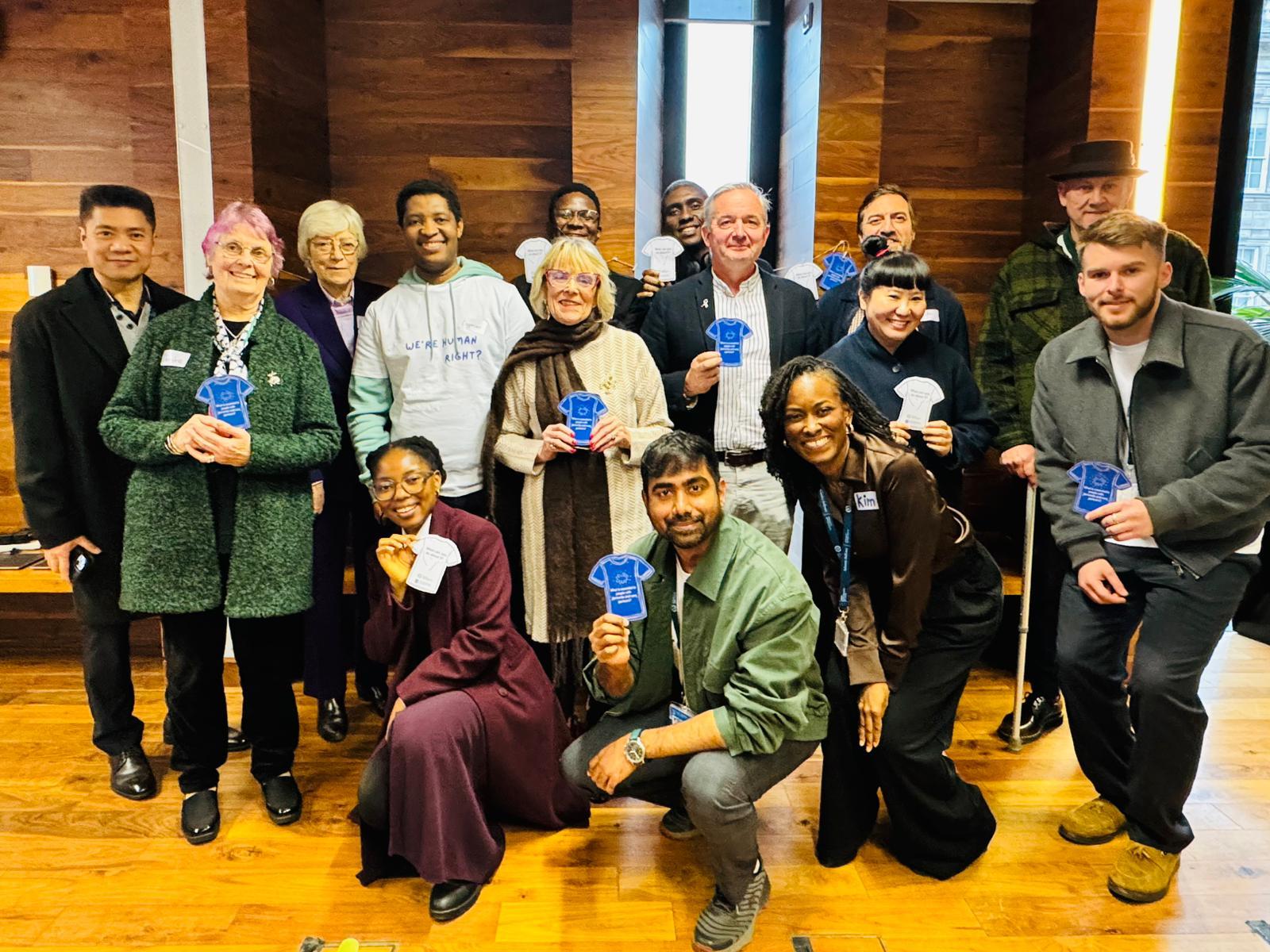
Atlantic Fellows with speakers at the Human Rights Day event in Trinity Long Room Hub. Photographs by: Rohith Khanna Deivasigamani, Atlantic Fellow for Equity in Brain Health.
“It only takes one good conversation to change your understanding of someone else’s world, your world, and the world at large.” – Celeste Headlee
All it took was one brief but good conversation about the rights of persons with dementia with Brother John-Richards Pagan, a US-based advocate living with Lewy Body Dementia during a Global Brain Health Institute (GBHI)-organised ‘Ask the Expert’ session, to catalyse an entire event on Human Rights Day* - A Conversation About Human Rights and Dementia at Trinity College Dublin.
With the idea of hosting a public conversation about human rights and dementia inspired by someone living with dementia, I was very keen to continue with the Public and Patient Involvement (PPI) approach of meaningfully centring the voices of people with lived experience. This approach has been a core aspect of my learning as an Atlantic Fellow for Equity in Brain Health. For me, this year's Human Rights Day theme of "Human Rights, Our Everyday Essentials" further underscored the importance of reflecting on the everyday rights that matter most to people with dementia and care partners, as well as highlighting the legal frameworks in Ireland and the European Union that seek to safeguard those rights.
Voices That Matter: Shaping the Conversation
Good conversations with the right people at the right time continued to be pivotal prior to the actual conversation on Human Rights Day.
At a PPI Ignite panel discussion on Lived Experience Research in Lewy Body Dementia in late November 2025, I met Eben Stewart, a care partner for his wife, Sandrine, who was diagnosed with Lewy Body Dementia, as well as Wayne Baron, who is determined to live his best life with his wife Siobhán and their children despite young-onset Lewy Body Dementia, and Deirdre McGarry, a fierce human rights activist and former care partner for her late husband, Edward Barker.
Then, during a GBHI-organised visit to the Irish Museum of Modern Art I met artist, Marie Brett, whose audio-visual artwork, ‘Yes, But Do You Care?’ explores the politics of autonomy, dementia care and Ireland’s capacity legislation. And it was only in early December 2025, at the launch of her co-authored book, ‘Human Rights in Dementia Care: A Good Practice Guide’ that I chatted with Helen Rochford-Brennan, who is living with Alzheimer’s Disease.
Good conversations, at the right time, with each of these individuals illuminated different corners of our unique yet connect worlds and it was a no-brainer that these experts, alongside Patricia Rickard-Clarke, Chair of Safeguarding Ireland and Trustee/Director of Sage Advocacy, should lead the conversation on human rights and dementia.
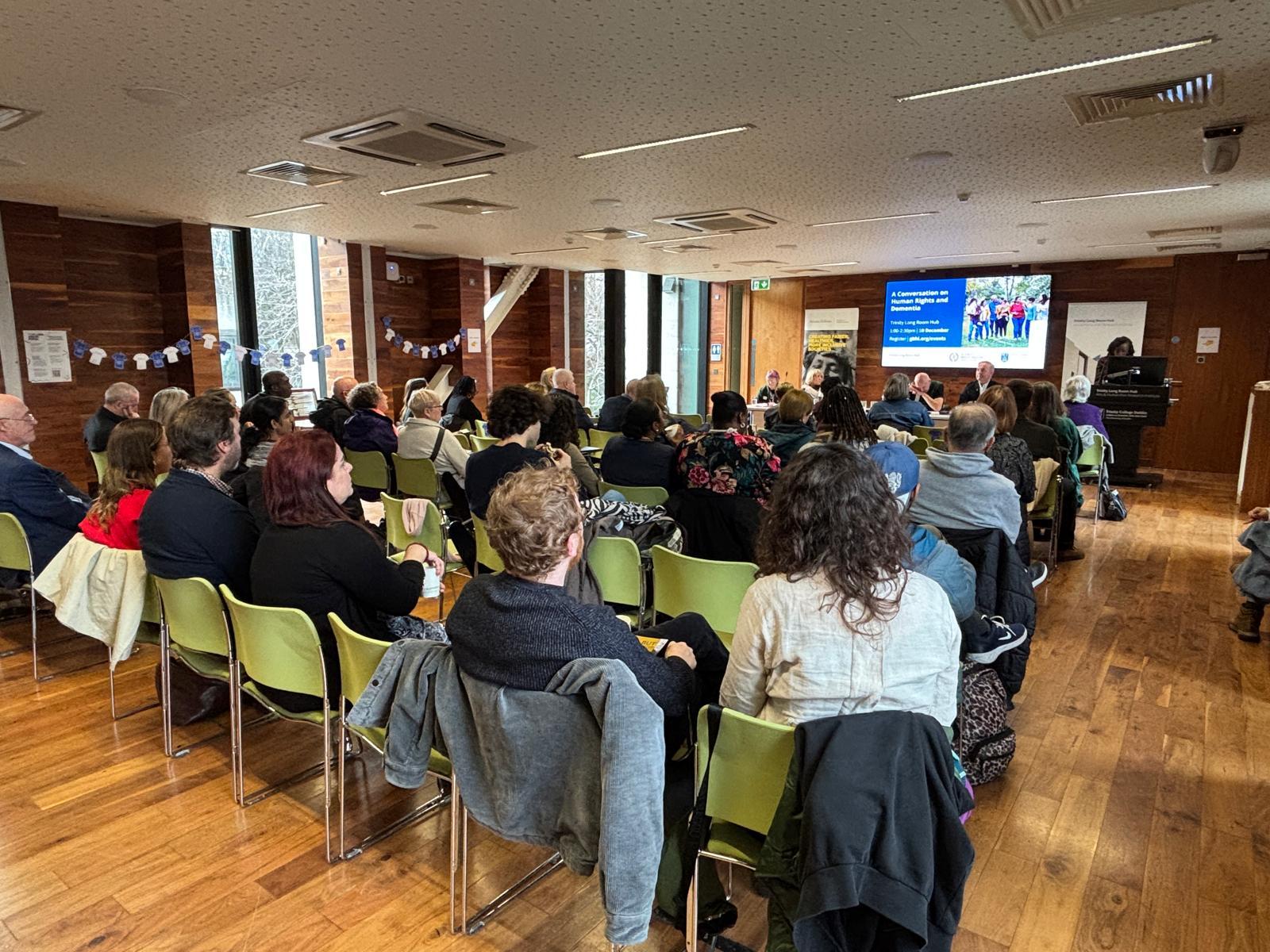
Guests listening to the conversation about human rights and dementia on Human Rights Day in the Trinity Long Room Hub.
Personal Stories Illuminating Human Rights
At the event itself, Eben moderated the conversation and opened by sharing his story as care partner and how his wife’s dementia progression outpaced the knowledge of the legal rights, ultimately leaving the family to grapple with the Assisted Decision-Making (Capacity) law in an emotional court process. He then invited speakers to candidly share their own stories of how dementia intersects with rights; allowing each voice to be heard clearly and without interruption. Through their stories, we gained a better understanding of their different, yet connected worlds.
Wayne spoke about the profound sense of loss he felt, not from the dementia diagnosis but from being stripped of his right to work as a chef and to financially support his family.
The diagnosis didn’t bother me so much but losing my job. That killed me. I lost the right to work. The right to provide for my family. I still had two kids in school.
– Wayne Baron, Dementia Expert by Experience
Meanwhile, Helen explained that she had spent her entire life prior to her diagnosis advocating for the rights of others, and yet, she struggled to advocate for herself when her own rights were being infringed as someone diagnosed with dementia under the age of 65 for whom there were no supports at the time. She explained her ongoing advocacy for the rights of persons with dementia to continue to live in their own homes and communities and to be adequately supported in doing so.
Decisions are made for us. They are made about us. If tomorrow, something happens to me… the only thing would be to send me to a nursing home. I don’t want to go to a nursing home.
– Helen Rochford-Brennan, Dementia Expert by Experience
Although both Wayne and Helen’s stories highlight ways in which societal structures and stigma sought to impede their ability to fully exercise their rights, what was striking was their determination to live their best lives; with Wayne traveling regularly with his family and Helen fully engaged in research and writing.
Legal and Creative Perspectives
As it relates to autonomy, Patricia reflected on the historic structures, such as Wards of Court under the Lunacy Regulations (Ireland) Act, 1871, which were complicit in the perpetuation of stigma and discrimination by excluding the participation of the persons with dementia in decision-making about them. However, her contributions to the conversation also highlighted the significant progress made since the introduction of the Assisted Decision-Making (Capacity) Act, 2015 which seeks to elevate autonomy and participation by providing a legal obligation to support and assist persons with disabilities in decision-making. “Plan ahead!” was her main mantra.
Marie‘s film reinforced several of these themes by illustrating the complex interplay between rights and responsibilities of care partners and the rights of persons with dementia, particularly in view of the capacity legislation in Ireland. Then, to close the event, Deirdre spoke passionately about her activism and her desire to see people with dementia placed ahead of the profits generated from their institutionalisation in private facilities.
A Conversation About Human Rights and Dementia reaffirmed for me the transformative power of conversation and collaboration. Behind this event, was the Trinity family – GBHI faculty, staff and fellows committed to advancing equity in brain health as well as the Trinity Long Room Hub Arts & Humanities Research Institute. And the conversations led by persons with lived experience reminded us all that rights are not abstract ideals, but everyday essentials for real people. Dementia does not erase those rights but actually demands their intentional realisation in all settings, for all people. After all, we’re human, right?
I hope that this Human Rights Day conversation provokes reflection on what truly matters for people with dementia and care partners, and promotes action on what we can do about it.
Background Information
*Each year, December 10th is recognised globally as Human Rights Day commemorating the United Nations General Assembly’s adoption of the Universal Declaration of Human Rights (UDHR) – a seminal document identifying fundamental human rights to be universally protected. The UDHR has since laid the foundation for several international human rights treaties (or agreements among States), including the Convention on the Rights of Persons with Disabilities – which in turn, has helped to shape national laws, such as Ireland’s Assisted Decision-Making (Capacity) Act, 2015.
Authors

Kimberley Benjamin, LLM, LLB, BSc
Attorney-at-Law
GBHI Members Mentioned

Rohith Khanna Deivasigamani, MD
Psychiatrist